Research
Publications .pdf .ps (last update December 2014)
/This page is under construction and will be expanded.
References will be added./
/Last update October 29, 2010./
Voronoi tessellations
|
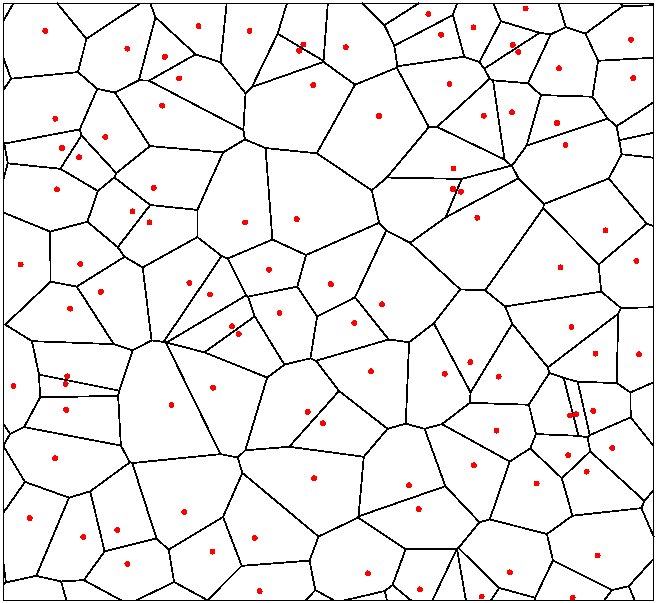
The three figures on the left represent what is called Poisson-Voronoi tessellations. The red dots are the "centers", randomly and uniformly distributed
in the plane
with unit density [mathematicians say that they are a Poisson process
of intensity 1].
Figure 1 is just a statistically average tessellation. You see that the Voronoi cells come in many different shapes and sizes. In particular, they have a variable number of sides. The probability distribution of this number of sides -- let's call it n -- is a quantity of interest. |
|||
| Figure 1 |
|
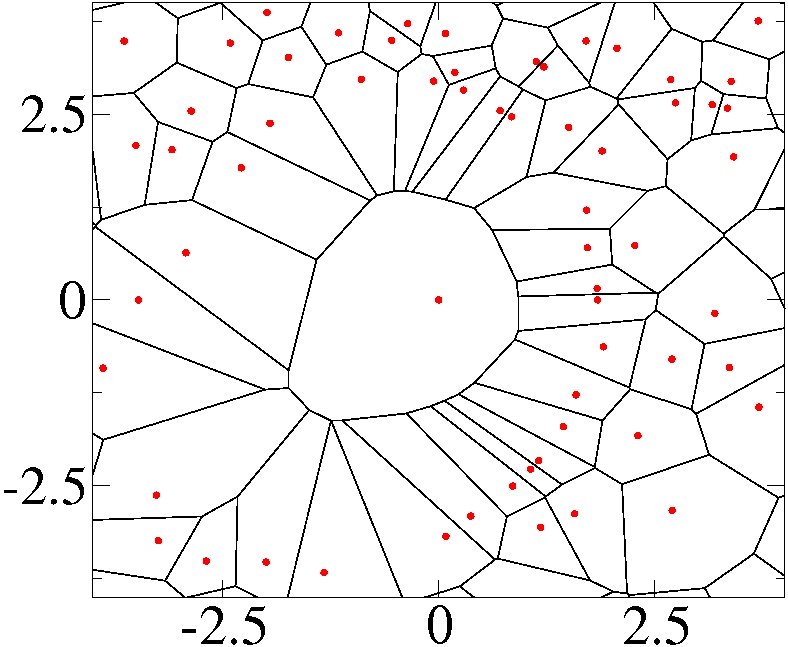
Figure 2 is a very exceptional tessellation in which there occurs a cell that is 24-sided! Such events are extremely rare. They have been the subject of my research in the period 2005-2008. Let us call pn the probability that a cell randomly picked from a tessellation have n=24 sides. For n=24 we have that p24 is only about 10-18. It is remarkable that most of the first-neighbor cells of the 24-sided "central" cell are quite elongated. This feature will become more and more pronounced when we increase the number of sides n. |
||
| Figure 2 |
|
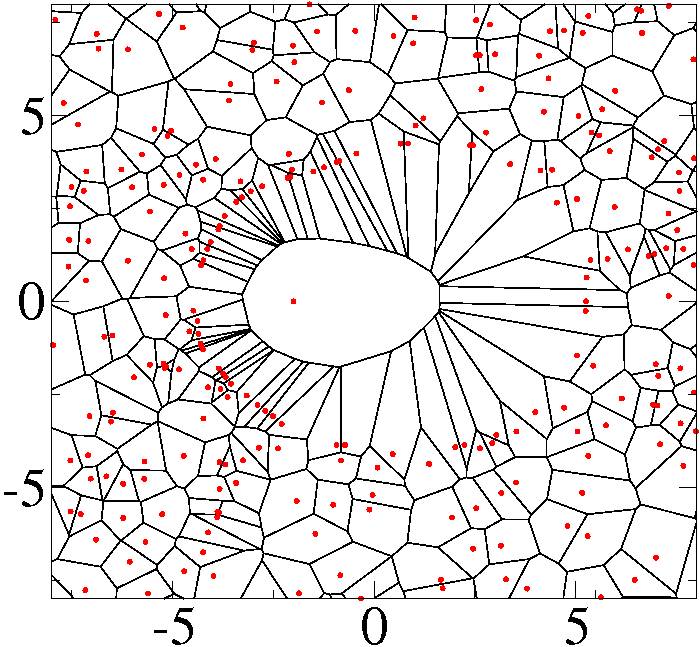
Figure 3 is even more exceptional than Figure 2. A cell occurs that is 48-sided! The probability for a cell to have 48 sides is only about 10-60. But if it does occur, it will look like shown in the figure. |
||
| Figure 3 |